

Most evidence systems write an audit log. Far fewer can tell you whether that log can be changed afterward — or by whom. ERIN7’s audit trail is append-only and hash-chained, so tampering isn’t merely prohibited. It’s detectable.
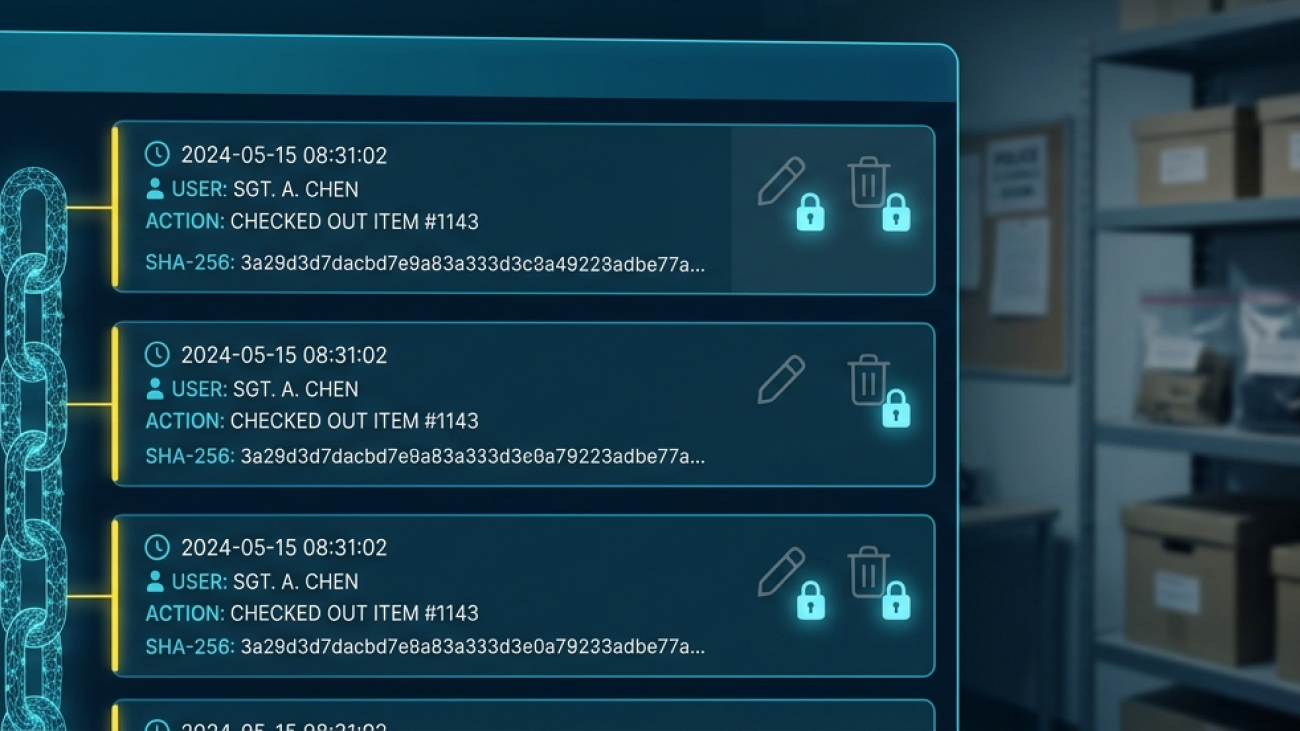
Most evidence systems write an audit log. Far fewer can tell you whether that log can be changed afterward — or by whom. ERIN7’s audit trail is append-only and hash-chained, so tampering isn’t merely prohibited. It’s detectable.
|
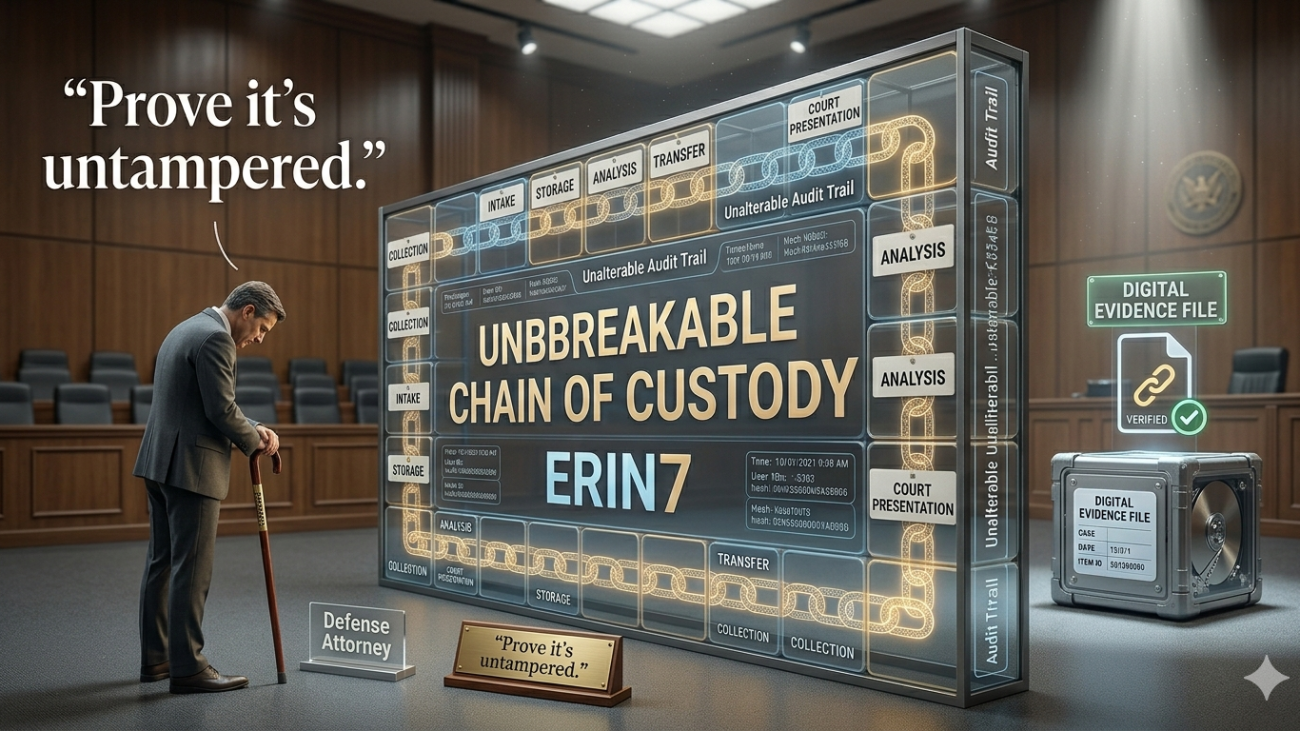
“Prove it’s untampered.” |
A defense attorney says those three words and every eye in the courtroom turns to your agency’s chain-of-custody. If your answer lives in a three-ring binder, a handwritten sign-out sheet, or a collection of spreadsheets spread across different folders, you are already at a disadvantage. Paper gets lost. Handwriting gets misread. Spreadsheets do not record who made a change or when. None of that belongs in a courtroom. None of it needs to.
ERIN7 was built to answer that question — completely, instantly, and in court. Every single action taken on a piece of evidence is recorded by the system automatically, without anyone having to remember to write it down. The result is a chain-of-custody that is unbroken, tamper-evident, and always ready to produce.
This article explains what ERIN7 records, how to access those records when it matters most, and why the details built into the system make evidence challenges extremely difficult to sustain.
Law enforcement has relied on paper-based evidence documentation for decades. Many agencies still do. And while paper works well enough in quiet times, it tends to fall apart under the pressure of a courtroom challenge.
Frank McCully, an investigator who oversees evidence operations at a New York sheriff’s office, described what it was like before his agency moved to a modern system. You can read his full account in our Madison County Sheriff’s Office case study. Officers would hand-fill property receipts, write out chain-of-custody forms by hand, and attach the paperwork to the item before it went to the evidence building. Someone there would enter it into software and put the item on a shelf. Every step was manual. Every step was a chance for error.
“The chain-of-custody, the continuity of that item and that paperwork, could make or break a case. There’s a lot of integrity built into the chain-of-custody for every single item that we receive into this building.”
(Customer Interview – Frank McCully, Madison County Sheriff’s Office)
The problems with paper are not theoretical. Handwriting gets misread. Fields get left blank. Documents get misplaced. There is no timestamp on a handwritten entry — just whatever date someone scribbled down, which may or may not be accurate. And if someone makes a change to a paper log, there is no record of what it said before the change was made.
A defense attorney does not need to prove the evidence was tampered with. They only need to create doubt. A missing entry, a crossed-out field, or a date that does not line up is enough to raise a question in a jury’s mind. ERIN7 eliminates those vulnerabilities.
Every time anyone in ERIN7 interacts with a piece of evidence, the system creates a permanent, timestamped record. This happens in the background, without any extra steps required from the user. There is no “log this action” button. It is always running.
For every transaction — check-in, check-out, transfer, move, disposal, or any status change — ERIN7 captures the following:
That last point matters more than it might seem. ERIN7 supports digital signatures collected through a touch screen, a Topaz Signature Pad, or a mouse-drawn signature. When an officer checks an item out for court, their signature is attached to that transaction. When it comes back in, the receiving officer’s signature is attached. The custody chain shows not just who handled the item, but who signed for it at every step.
Those records are append-only. No one can edit or delete an audit entry — not an administrator, and not ERIN Technology. See how ERIN7’s audit trail works.
Have more questions about how this works? Visit our Evidence Tracking FAQ for answers to common chain-of-custody questions.
When you need to show the court exactly what happened to a piece of evidence, the process in ERIN7 takes less than a minute. Navigate to the item record, locate the Chain-of-Custody tab, or select Chain-of-Custody Report from the report dropdown. The system generates a complete, chronological log of every action ever taken on that item — from the moment it was first entered to the present.
That report can be exported as a PDF or printed directly. It is formatted clearly, with every transaction listed in order, every user identified, and every timestamp visible. You do not summarize what happened to the evidence. You print the full record.
For agencies with large evidence rooms, the ability to search by case number, item number, or any other field and pull the relevant report in seconds is a significant operational advantage. In the middle of a trial, when an attorney or a judge asks for documentation, the answer is not “we’ll have to look into that.” It is a printed report, ready to go.
ERIN7 does more than track movement. It captures identifying details that make it nearly impossible for a defense attorney to argue that the wrong item was processed, or that the evidence in a photograph does not match what was actually collected.
A digital forensics unit, for example, can configure ERIN7 to capture the device type, the serial number, and the IMEI number of every phone or tablet that comes through intake. The IMEI number is unique to each device worldwide. If an attorney in court questions whether the device in an evidence photo is the same device that was processed and analyzed, the IMEI number recorded at intake — and matched in the lab report and the photograph — provides a definitive answer.
One forensics lab described exactly this scenario: seven defendants being tried at the same time, with defense attorneys challenging whether the evidence being presented was the same evidence that had been processed. Because unique identifiers had been recorded in ERIN7 at intake, cross-referenced in reports, and captured in photographs, the chain of evidence was airtight.
ERIN7 allows administrators to create as many custom fields as needed and organize them by item category. A drug evidence record can capture different fields than a firearm record, which can capture different fields than an electronic device record. Every field is configured once and then becomes a permanent part of the intake form for that category — ensuring that the right information is always collected consistently, not just when someone remembers to ask for it.
The integrity of evidence records is not just about what the software captures — it is also about where those records live and how they are protected. ERIN7 is hosted on Microsoft Azure Government Cloud, the same infrastructure used by federal, state, and local government agencies across the country. Every agency’s data is kept in its own separate database, completely isolated from other customers’ records.
All access to ERIN7 is encrypted using TLS 1.2 with 256-bit certificates. This means that data moving between your agency’s devices and the server cannot be intercepted or read by anyone outside the system. Learn more about our full compliance and security standards, including CJIS, FIPS 140-2, FedRAMP, and SOC 2 Type II certification.
These certifications matter in court. When the integrity of your records is questioned, you are not relying on a verbal assurance that the system is secure. You have the documentation to prove it.
Chain of custody does not end when an item leaves the evidence room for the last time. Disposal documentation is part of the legal record, and gaps in that documentation can create liability long after a case is closed.
In ERIN7, the disposal workflow captures the disposal method (destroyed, returned to owner, transferred to another agency, etc.), the officer who performed the disposal, a witness, the date, the time, and optional notes. Each of these fields is required before the system will complete the disposal process. Nothing can be skipped.
If an item is later un-disposed for any reason, ERIN7 preserves the original disposal record and documents the reason for the status change. The history is never overwritten — it accumulates, so the full lifecycle of every item is always visible.
|
Action |
What ERIN7 Records |
|
Check-In |
User, date/time, storage location, received by, item status, notes, signature |
|
Check-Out |
Issued by, taken by, date/time, reason, expected return date, signature |
|
Transfer |
Delivered by, received by, new location, reason, date/time, signature |
|
Move |
Delivered by, received by, new location, reason, date/time |
|
Status Change |
What changed, who changed it, previous value, new value, when |
|
Disposal |
Method, disposed by, witness, date/time, notes, signature |
|
Undispose |
Reason for reversal, new status — original disposal record fully preserved |
|
Any Field Edit |
Field name, old value, new value, user who made the change, timestamp |
Defense attorneys challenge evidence when they sense a gap — a missing log entry, an unexplained break in custody, a record that does not match a photograph. The challenge is rarely that the evidence was actually tampered with. It is that the documentation leaves room for doubt.
ERIN7 closes those gaps before they form. Every action is logged. Every user is identified. Every transaction is timestamped. Every signature is captured. The chain-of-custody report is one click away, ready to be printed and handed to a judge or placed in a case file.
When the challenge comes — and it will — your agency will not need to scramble for answers. The answers will already be there, organized, complete, and impossible to question.
Want to see how ERIN7’s chain-of-custody reporting works for your agency?
Contact ERIN Technology at (855) 558-3746 or visit erintechnology.com
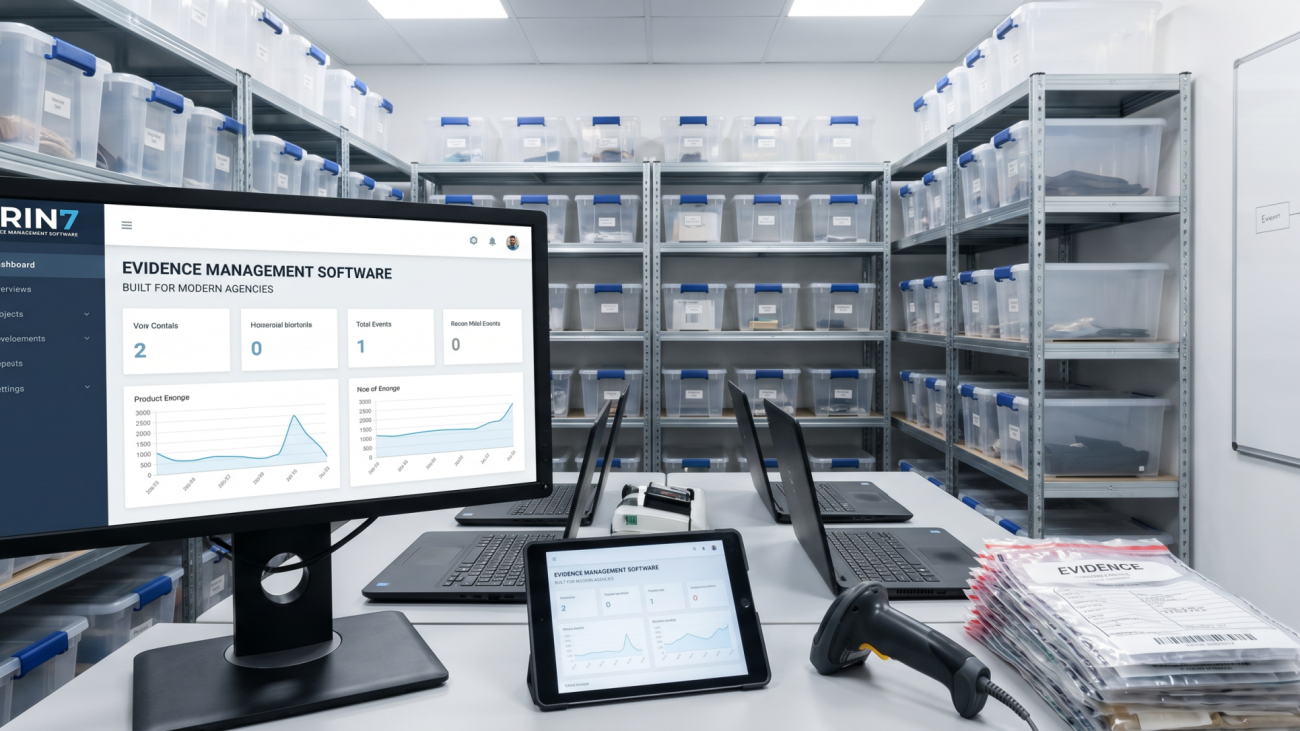
ERIN7: The Evidence Management Software Built for the Way Modern Agencies Actually Work
Law enforcement and corrections agencies bear an enormous responsibility regarding evidence. A single mishandled item, a missing entry in the chain of custody, or a documentation gap can compromise an entire investigation, derail a prosecution, or expose an agency to serious legal and regulatory consequences. As caseloads grow, evidence rooms fill faster, and digital media becomes an ever-larger part of every investigation, the tools agencies rely on to manage evidence must keep pace.
ERIN7, developed by ERIN Technology LLC, is a comprehensive evidence management platform purpose-built for modern law enforcement agencies, corrections departments, and government organizations. It was designed not by software engineers working in a vacuum, but by evidence professionals who understand the daily pressures of running a compliant, audit-ready evidence operation. The result is a system that doesn’t just digitize old processes — it fundamentally improves them.
One Platform for Every Type of Evidence
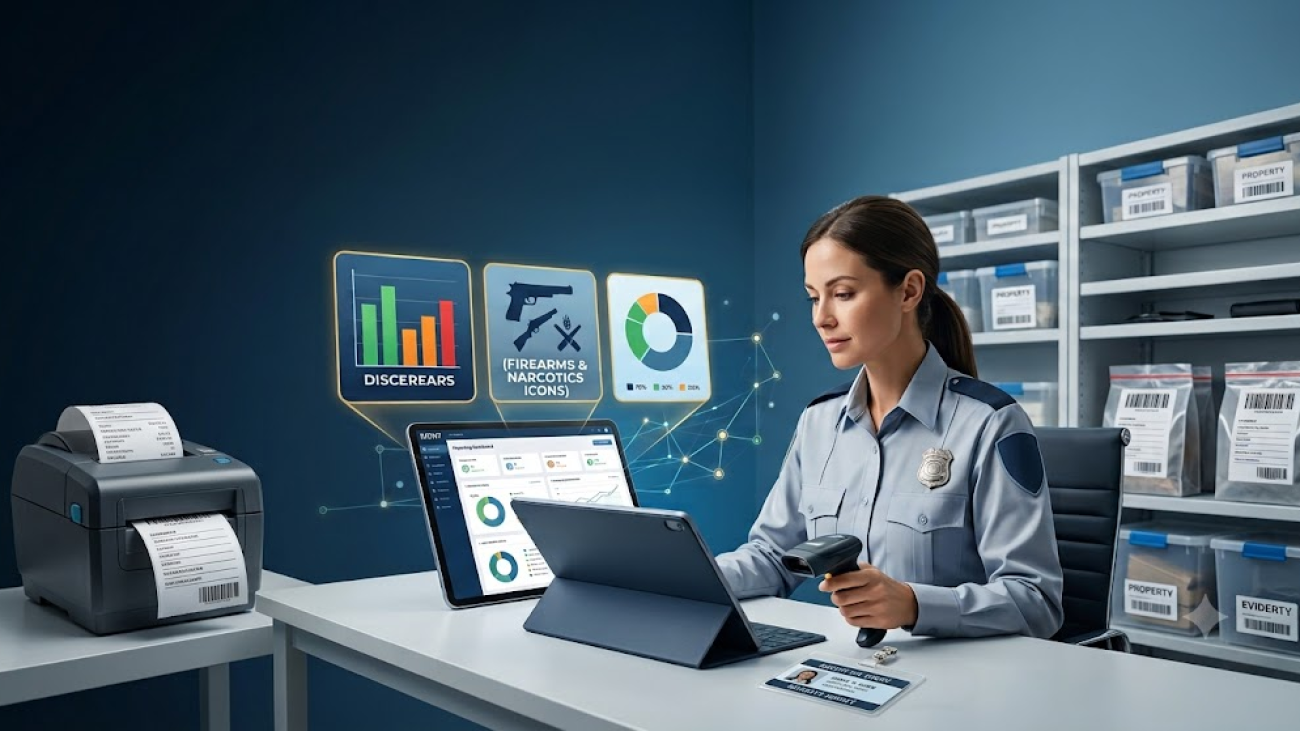
One of the most persistent challenges facing evidence managers today is fragmentation. Physical evidence — firearms, narcotics, currency, clothing, documents — often lives in one system, while digital evidence — mobile devices, hard drives, body camera footage, surveillance video — is tracked separately, if at all, in a systematic way. The result is a patchwork of spreadsheets, binders, and disconnected software that creates accountability gaps and multiplies audit headaches.
ERIN7 solves this by bringing both physical and digital evidence management into a single, unified platform. Whether your agency is processing a firearm seized at a crime scene or ingesting terabytes of data from a forensic examination, ERIN7 handles it within the same system, under the same chain of custody framework, and with the same robust audit trail.
The platform supports a wide range of evidence types and workflows, including:
This breadth of capability means agencies no longer need to stitch together multiple products to manage their evidence room. ERIN7 is the single source of truth.
Chain of Custody: Built to Be Unbreakable
In evidence management, the chain of custody isn’t just paperwork — it’s the legal backbone of every case. A break in the chain can render evidence inadmissible, undermine witness credibility, and give defense attorneys grounds to challenge even the most straightforward prosecutions.
ERIN7 was architected with chain-of-custody integrity as a foundational principle, not an afterthought. Every action taken within the system — whether it’s checking an item out for court, transferring custody between personnel, conducting an audit scan, or updating a record — is automatically logged with a full before-and-after snapshot of the data. This creates an unalterable, time-stamped audit trail that documents exactly who did what, when, and what the record looked like before and after the action.
Key chain of custody features include:
This level of documentation means that when an attorney, auditor, or accreditation body asks for a complete record of an item’s history, ERIN7 produces it instantly and completely.
Cloud or On-Premises: Flexibility Without Compromise
Different agencies have different infrastructure needs and IT policies. Some are ready to move fully to the cloud. Others have legacy infrastructure, bandwidth constraints, or organizational policies that require on-premises installation. ERIN7 accommodates both without sacrificing functionality.
Microsoft Azure Government Cloud is ERIN7’s recommended deployment path for agencies seeking maximum security, compliance, and accessibility. Azure Government is specifically designed for public sector organizations and provides a security and compliance framework that meets or exceeds the rigorous standards law enforcement demands. ERIN7’s Azure-hosted deployment includes:
For agencies that require or prefer local control, ERIN7’s on-premises installation delivers the same full feature set within the agency’s own infrastructure.
Unlimited Customization — No Programmers Required
No two agencies operate exactly alike. Policies differ. Workflows differ. The categories of evidence, the forms required for intake, and the approval chains for disposal — all of these vary by jurisdiction, agency size, and operational philosophy. Many evidence management systems force agencies to adapt their workflows to fit the software. ERIN7 takes the opposite approach.
Administrative users — not software developers — have complete control over how the system looks, behaves, and what data it captures. Through ERIN7’s administrative interface, authorized users can:
This level of customization means ERIN7 adapts to your agency — not the other way around. And because no custom programming is required, agencies can make changes themselves as policies and needs evolve, without waiting on a vendor or paying for development time.
Mobile-Ready for the Field and the Evidence Room
Evidence work doesn’t happen only at a desktop terminal. Officers submit evidence in the field. Detectives pull case files from the road. Evidence technicians move through storage areas scanning hundreds of items during audits. A modern evidence management system needs to work everywhere people work — and ERIN7 does.
The platform is fully responsive and runs on any device with a modern web browser: smartphones, tablets, laptops, and desktop workstations. There’s no special app to install, and there are no device restrictions. Whether a staff member is on an iPhone, an Android tablet, or a Windows laptop, they get the same full-featured experience.
Mobile-specific capabilities include:
For evidence technicians conducting large-scale physical inventories, the ability to walk through a storage room with a tablet and scan items in real time — while ERIN7 automatically flags discrepancies — is a dramatic efficiency improvement over paper-based or manual processes.
Built for Audits, Accreditation, and Compliance
Accreditation bodies, internal affairs offices, prosecuting attorneys, and oversight agencies all have one thing in common: they want documentation. The ability to prove, quickly and completely, that evidence was handled properly throughout its entire lifecycle is what separates agencies that pass audits with confidence from those that scramble to reconstruct records at the last minute.
ERIN7 is built audit-first. Every report an auditor or accreditor would want is either built into the system or can be created without programming through custom reporting tools. Inventory discrepancy reports identify items that are missing or out of place. Chain of custody reports provide a complete legal record for any item. Retention and disposition workflows ensure that evidence isn’t held longer than policy requires — and that disposal is properly documented when it occurs.
Investigator Brandy Jones of the Rockdale County Sheriff’s Office describes the difference ERIN7 made in her agency’s compliance operations: “It has definitely made it a lot easier for me… the inventory, the scanning, the audits.”
Proven at Scale Across Agencies of All Sizes
ERIN7 is trusted by law enforcement and corrections agencies across North America, from small municipal police departments to large state-level corrections systems. Its architecture is designed to scale, handling everything from a department with a few hundred evidence items to operations managing tens of thousands of items every month.
The Georgia Department of Corrections Digital Forensics Unit, for example, processes an extraordinary volume of digital devices. Megan Radcliffe of that unit explains: “We’re receiving somewhere between 1,000 to 1,500 devices every single month… and ERIN has really helped us track all kinds of things.”
Whether an agency needs to track a modest evidence room or manage enterprise-scale digital forensics operations, ERIN7 delivers the same reliability, auditability, and performance.
The Technical Foundation Agencies Can Trust
ERIN7 is built on a modern, maintainable technology stack: Microsoft .NET Core and SQL Server, with a responsive web architecture that reflects current best practices in enterprise software development. This matters because agencies investing in an evidence management platform are making a long-term commitment. A platform built on modern, widely supported technologies is far less likely to become obsolete or unsupported than one built on legacy frameworks.
Direct integration with Zebra label printers allows evidence labels to print without the intermediate PDF step that slows down other systems. Advanced search capabilities let users locate evidence by case number, item barcode, person name, category, serial number, and more — making it fast to find exactly what’s needed without wading through records manually.
SOC 2 and HECVAT Certified: Security You Can Document
For agencies that must satisfy procurement officers, IT security teams, or institutional stakeholders before adopting a new platform, ERIN7 goes beyond mere claims of security — it can prove it.
ERIN7 is SOC 2 compliant, meaning it has undergone an independent third-party audit against the American Institute of Certified Public Accountants (AICPA) Trust Services Criteria. SOC 2 certification examines how a software platform manages customer data across five key areas: security, availability, processing integrity, confidentiality, and privacy. Achieving SOC 2 compliance is not a checkbox exercise — it requires demonstrating that controls are not only in place but are operating effectively over time. For law enforcement and government agencies, this provides a vendor-neutral, auditor-verified assurance that ERIN7’s security practices meet rigorous professional standards.
ERIN7 also completes the HECVAT (Higher Education Community Vendor Assessment Tool), a standardized security questionnaire widely used by higher education institutions and increasingly adopted by government and public sector procurement teams to evaluate third-party technology vendors. HECVAT responses address data governance, incident response, encryption practices, business continuity, and more — providing procurement and IT security teams with a comprehensive, structured view of how ERIN7 manages data security and risk.
Together, SOC 2 compliance and HECVAT completion mean that when your agency’s IT department, legal counsel, or procurement office asks the hard questions about vendor security, ERIN7 has the documentation to answer them. These certifications are especially valuable in environments where formal vendor risk assessments are required before a contract can be signed, reducing the time and friction involved in getting a new system approved and deployed.
Ready to Modernize Your Evidence Management?
Whether your agency is currently managing evidence in spreadsheets, using an outdated legacy system, or simply looking for a platform that can grow with your needs, ERIN7 offers a proven, modern solution designed specifically for the demands of law enforcement and corrections work.
The combination of a rigorous chain of custody framework, unlimited customization, cloud and on-premises deployment options, mobile accessibility, and a compliance-first design makes ERIN7 one of the most capable and adaptable evidence management platforms available today.
Contact ERIN Technology LLC to schedule a demo and see ERIN7 in action:
 855-558-3746
  www.erintechnology.com
See how ERIN7 can simplify evidence management, reduce administrative workload, and strengthen chain of custody integrity across your organization.