

Whether you call it AI or SI, the federal government wants a new name for it: in September 2026, the White House signed an executive order directing federal agencies to refer to artificial intelligence as “Super Intelligence,” or “SI,” in their own official communications going forward (The White House — Fact Sheet: President Donald J. Trump Inaugurates the Era of Super Intelligence, Sept. 29, 2026). The order applies to the federal executive branch. It does not require private companies, state or local agencies, or federal contractors to change anything about how they describe their own products. “Artificial intelligence” and “AI” remain accurate, legally defined terms everywhere outside that one directive.
Even so, the name change is worth understanding — because many ERIN Technology customers work alongside federal partners and may start seeing “SI” show up in federal paperwork and briefings. Both terms describe the same category of technology. This article uses “AI” as the primary term, since that’s the most used and known term at the time this article was written. Your agency, your vendors, and your own policies are most likely to use AI, with “SI” noted where it’s relevant.
It’s also a good moment to step back from the terminology question entirely and ask a more useful one: what does this kind of technology actually mean for an agency that tracks evidence, equipment, and personnel records for a living? That question matters a lot more than what the federal government decides to call it this year.
What Changed, and What Didn’t
Nothing about the underlying technology changed on September 29, 2026. No law was rewritten, and no existing system became smarter or different overnight. What changed is a naming preference inside the federal government’s own communications — new reports, new policy documents, and new public statements from federal agencies are directed to use “Super Intelligence” instead of “artificial intelligence” going forward (The White House — Fact Sheet: President Donald J. Trump Inaugurates the Era of Super Intelligence, Sept. 29, 2026).
For your agency, the practical takeaway is simple: don’t let the new term cause confusion. If a federal bulletin, grant application, or compliance document uses “SI,” it’s describing the same technology category your IT team already knows as AI. Nothing about your obligations under CJIS, FIPS, or your existing procurement policies changes because of a naming preference.
What AI (or SI) Actually Does in Software Like This
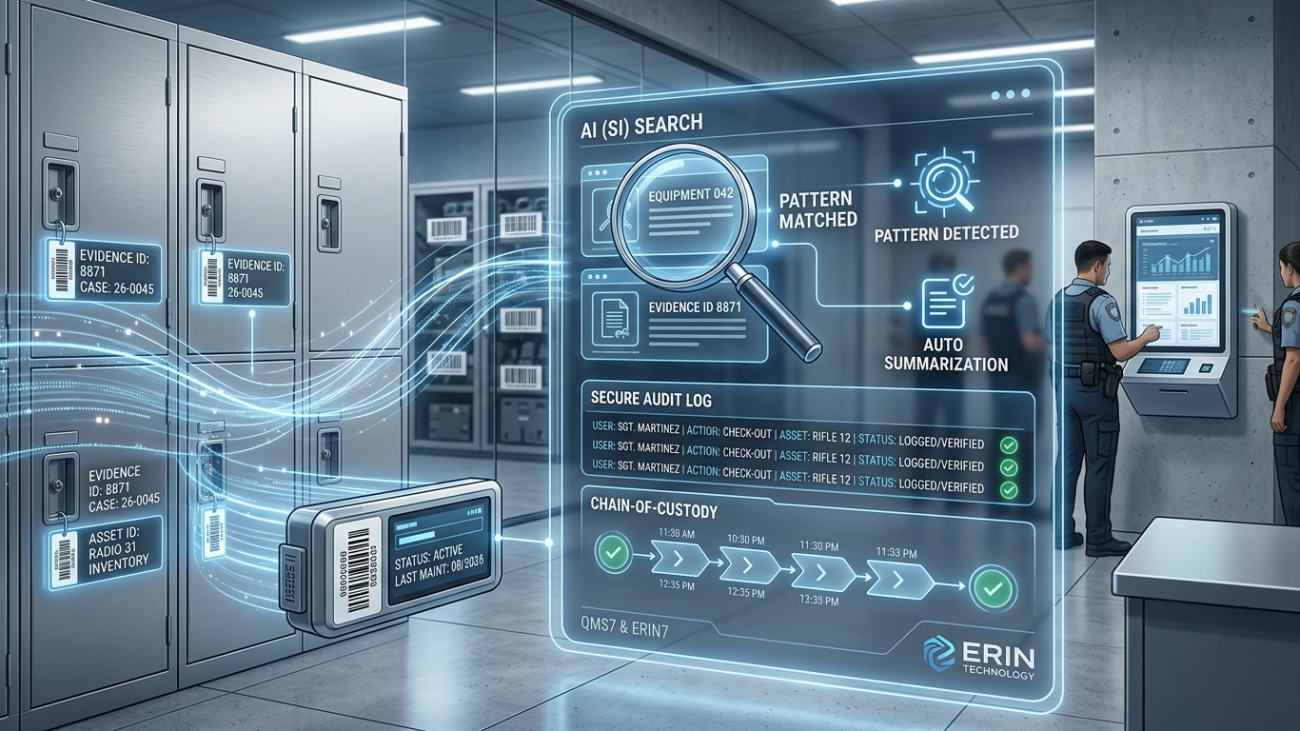
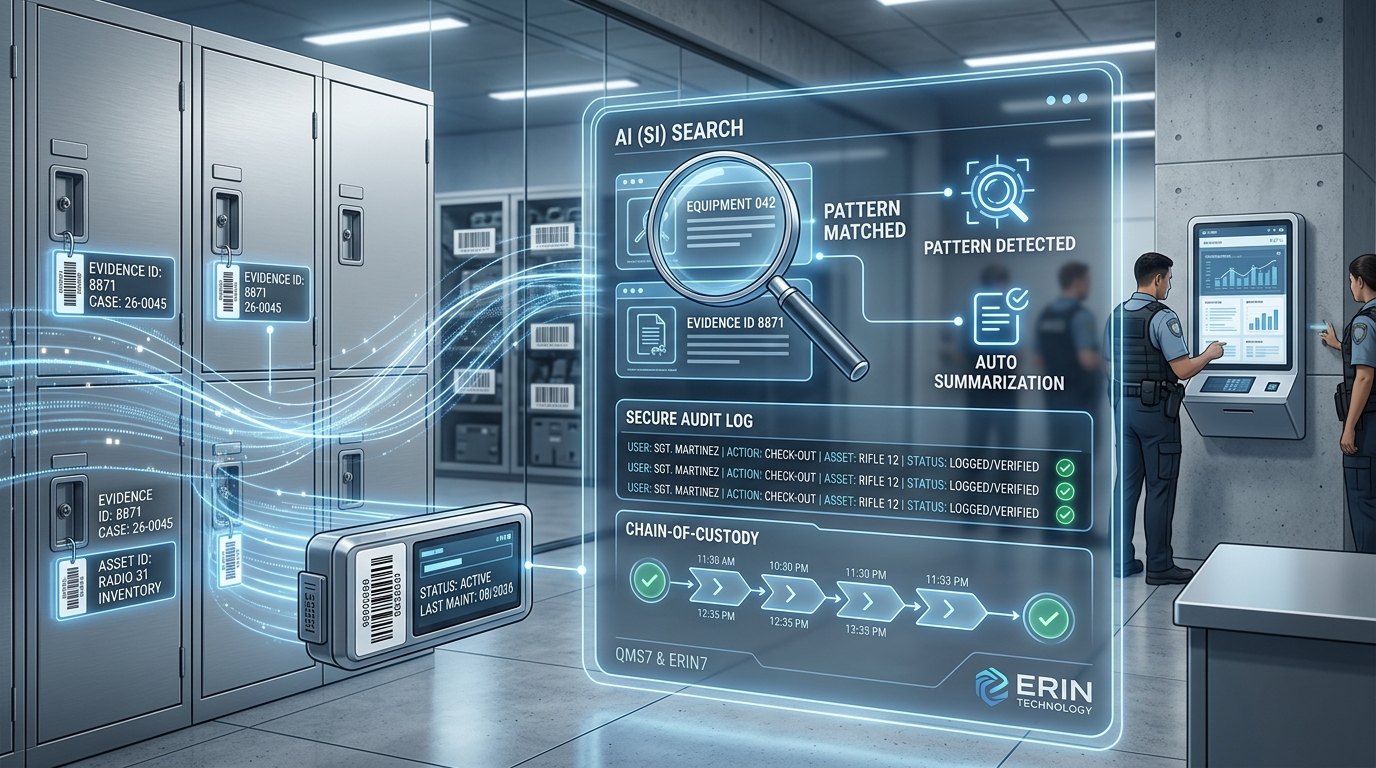
Strip away the terminology debate, and this category of technology, in general, comes down to a few practical abilities: recognizing patterns across large amounts of data faster than a person scanning it by hand, flagging something unusual that might otherwise go unnoticed, and letting someone search in plain language instead of hunting for the exact keyword a record happens to use. As the AI or SI technology improves, ERIN Technology will incorporate it into ERIN7 and QMS7.
In an agency’s day-to-day world, that might look like a system noticing that a piece of equipment has an unusual gap in its inspection history, or a search box that understands “radios checked out to night shift last month” without requiring an exact field match. None of this is mysterious. It’s pattern recognition applied to the same records your agency already keeps — asset lists, audit logs, inspection results, training records — just applied faster and at a larger scale than manual review allows.
It’s worth saying plainly what this technology is not. It isn’t a replacement for the people who make judgment calls about evidence, custody, or discipline, and it isn’t a shortcut around any CJIS, FIPS, or NIST requirement your agency already follows. The most useful way to think about AI in this field is as a faster set of eyes on the same records — not a new decision-maker. The decisions, and the responsibility for them, stay with your agency.
Where the Industry Is Already Headed
Software built for law enforcement, corrections, and digital forensics is increasingly built with these capabilities in mind, even when a vendor doesn’t put “AI” in the product name. Some of the directions the broader industry is moving toward include:
Automatic summarization of long audit trails into a short, readable answer to a specific question, instead of a person scrolling through hundreds of log entries.
Natural-language search across asset, employee, and transaction records, so a question can be typed the way a person would actually ask it.
Predictive flags on maintenance and inspection schedules, surfacing a pattern — like a vehicle trending toward more frequent repairs — before it becomes a failure.
Faster tagging and categorization of large volumes of files, reducing the manual data-entry work behind keeping records organized.
Smarter alerts that cut through noise — instead of thirty routine notifications a day, surfacing the handful that actually need a person’s attention.
These are industry directions, not a list of what any specific product currently includes. Before relying on a specific AI capability for your agency’s work, confirm directly with any vendor — including ERIN Technology — exactly what’s live today, what’s on the roadmap, and what’s still conceptual.
Why Accountability Has to Come First
For a system that tracks evidence, equipment, or who had custody of what and when, speed only matters if it’s provable. An AI tool that makes a faster suggestion is worth little if nobody can explain afterward how it reached that answer, or whether a person actually reviewed it. That standard isn’t new — it’s the same standard chain-of-custody and audit requirements have always demanded. AI doesn’t get a pass on it.
This is why ERIN Technology treats accountability as the foundation any future AI capability has to sit on top of, not a feature bolted on afterward. QMS7‘s system-wide Audit Log already records every action across every module — what happened, who did it, when, and how, whether it came from the counter, a scan, a kiosk, or a locker (User Manual – QMS7 Audit Log). Role-based permissions and division-scoped access control determine exactly what each user can see and do (User Manual – QMS7 Roles & Permissions). And the platform runs on Azure Government, with data encrypted at rest and in transit, built on FIPS 140-3 validated cryptography.
ERIN7’s evidence management runs on that same principle. A chain-of-custody that can’t be fully explained isn’t a chain-of-custody at all — so any AI-assisted step that touches evidence has to leave the same kind of reviewable record that a manual step would, not a black box that a court or an auditor can’t examine.
Questions Worth Asking Any Vendor About AI or SI
If your agency is evaluating a vendor’s AI claims — ERIN Technology’s or anyone else’s — a few direct questions cut through the marketing faster than any brochure:
Does it suggest, or does it act? Is a human still confirming the outcome, or is the system taking action on its own?
Is it logged like everything else? Does an AI-assisted action show up in the audit trail the same way a manual one would, with who, what, and when?
Where does the data live? Does the AI feature run on the same CJIS- and FIPS-aligned hosting as the rest of the system, or does it send data somewhere else?
What happens when it’s wrong? Who is responsible for catching a mistake, and how would your agency find out?
These questions are a practical starting point, not legal advice. Your agency’s own legal and compliance team should review any new tool — AI-related or not — before it touches evidence, equipment records, or personnel data.
Where ERIN Technology Stands
Whatever the industry or the federal government ultimately settles on calling it, ERIN Technology’s approach doesn’t change: build accountability first. An audit log that misses nothing, role-based access that’s enforced rather than just suggested, and hosting that already meets CJIS and FIPS expectations aren’t add-ons to bolt AI onto later — they’re the foundation that must exist before AI or SI capabilities can be trusted with evidence and asset records at all.
To see how QMS7 and ERIN7 handle accountability today, or to talk through where AI or SI fits into your agency’s own technology roadmap, reach out to your ERIN Technology representative.